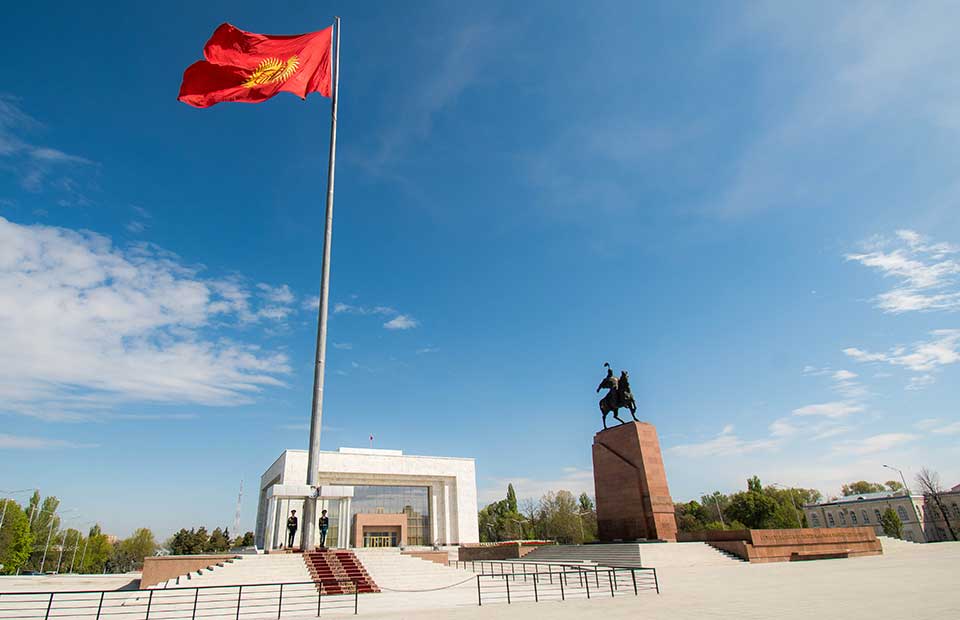
The Linguistic Landscape
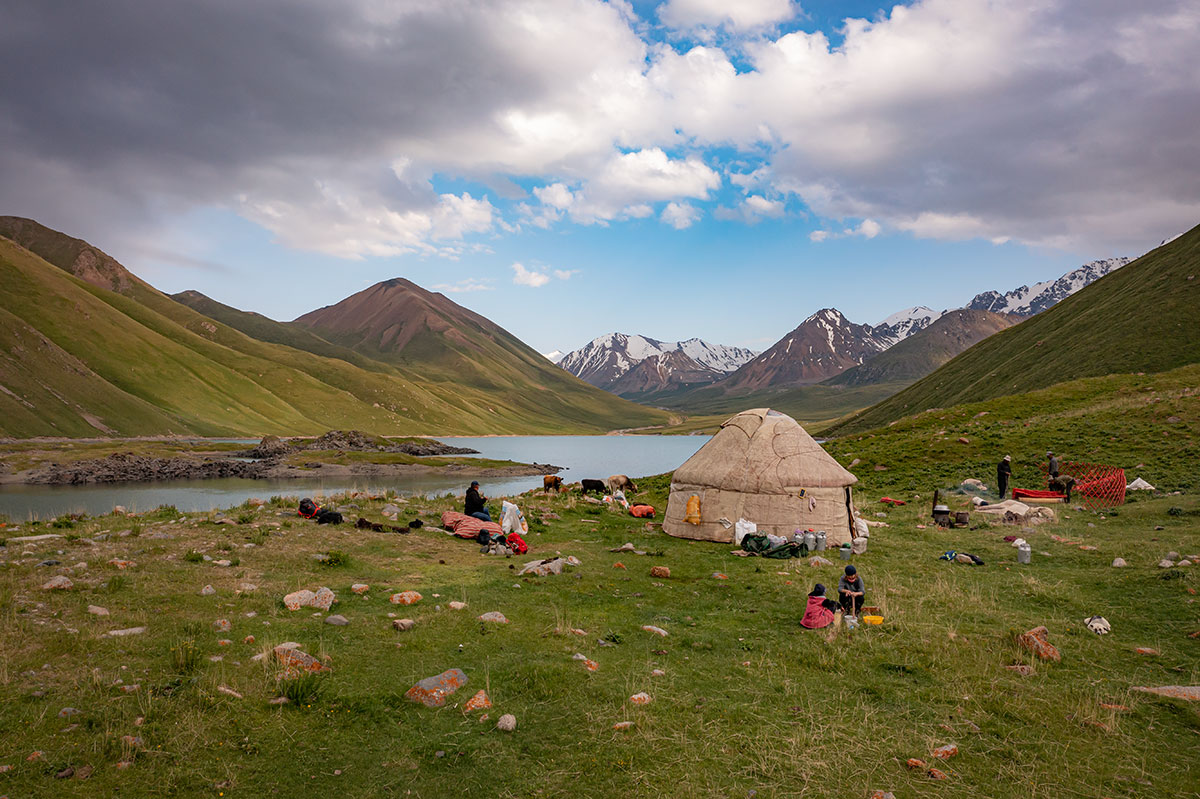
In Kyrgyzstan, the population is mostly bilingual, or even multilingual. It is important to distinguish between the two main languages: Russian, the administrative and lingua franca, widely spoken in cities, and Kyrgyz, the national and cultural language, predominant in rural areas and in yurts.
Although the language barrier is real, as English is not widely spoken in shops, markets (bazaars), or local eateries (ashkana), communication is still possible with a little preparation.
All is not lost for English speakers! In Bishkek, the capital, the younger generation is increasingly proficient in English, and you’ll even encounter a few French speakers.
Communicating Tools
The Google Translate or DeepL app will be your best allies for communicating almost fluently orally and for deciphering your menu. However, keep in mind that while the app handles spoken Russian perfectly, it only understands Kyrgyz in writing (manual entry or photo). You won’t be able to record someone speaking Kyrgyz for an instant translation.
Also, since mountains cover more than 90% of the country, you’ll often find yourself without any mobile network coverage. Be sure to download Russian and Kyrgyz dictionaries to your phone before leaving the city.
In remote areas, having a local guide is more than just a convenience, it’s a cultural bridge. It will facilitate your interactions with shepherds, for example, and enrich your experience.
Furthermore, the alphabet used is Cyrillic. Learning to decipher these characters, even without understanding the word, is a major advantage for reading menus or identifying your destination on the signs of marshrutkas (local minibuses).
Hospitality
While mastering Russian is generally more useful in the world and therefore certainly more motivating to learn, Kyrgyz people will always appreciate someone who uses Kyrgyz, even for formalities like thank you, hello, and how are you?
Finally, never underestimate non-verbal communication. A smile and a few polite words open all doors. Here is a small Kyrgyz survival kit (Phonetic):
Hello = Salamatsyzby
How are you? = Kandaysız ?
Merci = Rakhmat
Oui / Non = Ooba / Jok
Délicieux ! = Tamashatuu!
________________________________________
Travelling to Kyrgyzstan
Navigating the Uncharted Territory
Even though some parks like Ala Archa are marked, Kyrgyzstan remains a wild land where it’s easy to lose your bearings. For your hikes, don’t forget to download apps like Maps.me or Mappy.com. The key to success is planning ahead: download local maps before you leave. These tools use your phone’s GPS signal (which works offline) and allow you to follow your route even in the middle of nowhere, essential safety in a country where trails can sometimes be mistaken for cattle tracks.
Local Expertise
Why use a local agency in 2026? Because Central Asia remains an untamed region. Establishing your own itinerary across the steppes and steep mountain passes is a significant challenge. Local professionals have spent years experimenting with and securing the best routes, whether for a horseback expedition, a motorcycle tour, pure trekking, or off-road 4×4 adventures.
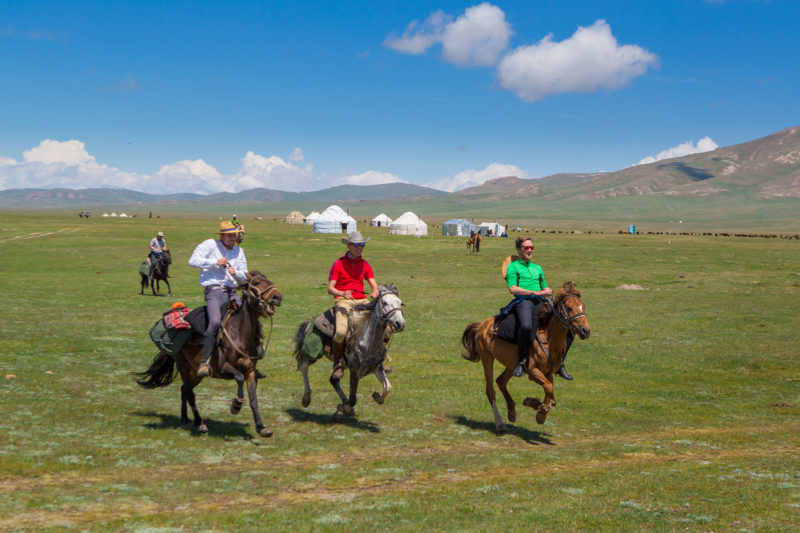
Beyond logistics, these experts know where to spot wildlife, such as golden eagles, or, for the luckiest, snow leopard tracks. Furthermore, it’s virtually impossible to find a herder willing to entrust you with their horses for a multi-day trek on your own, in a random valley. The agency is the essential bridge between your dream of adventure and the reality of nomadic life.
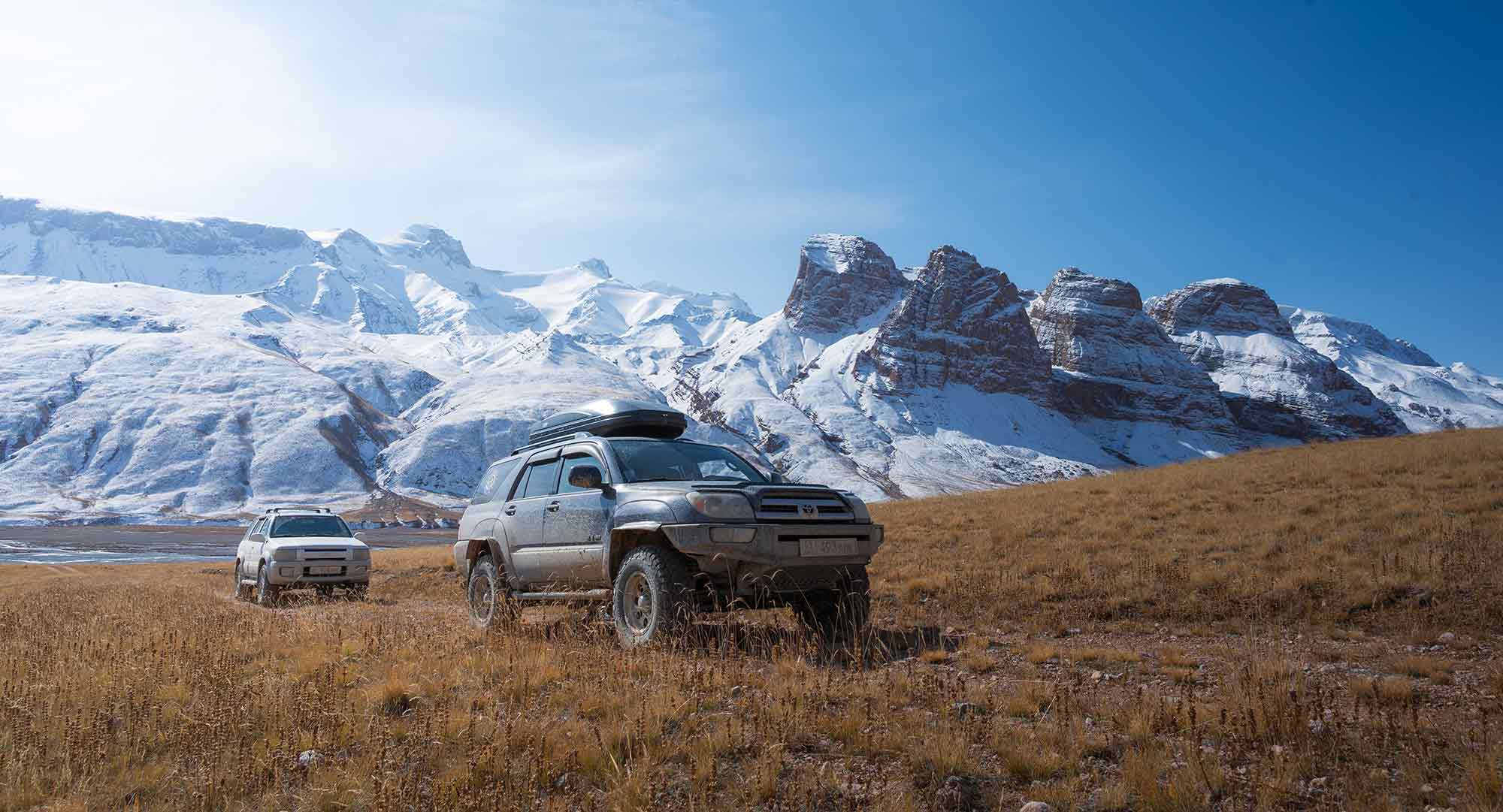
Regarding road accessibility, it’s important to know that a large portion of the country’s roads, particularly in the mountains, are impassable outside of the summer months. And most of them require a 4×4 vehicle.
1. Driving in Kyrgyzstan
While the landscapes are breathtaking, travelling long distances in Kyrgyzstan demands constant vigilance. Even if you’re a careful driver, Kyrgyz roads will offer no quarter. Between unpredictable potholes and flying gravel, returning a rental car in the same condition as when you picked it up is extremely difficult. From personal experience, the costs for material damage (chips in the windshield or bodywork) can quickly escalate upon return, a process that often proves lengthy and tedious.
The concentration required to drive here is exhausting. The country is riddled with speed cameras and radar detectors, but beware: the flash is invisible. You can be flashed multiple times without even realising it, and only discover the bill at the end of your trip. Between constantly monitoring your odometer, avoiding potholes and locating speed cameras, a day on the road will leave you exhausted.
If stopped by police for a questionable ‘fine,’ don’t rush to pay cash; instead, call your local agency or guide immediately. Having a local professional bridge the language barrier is your best defence against intimidation and ensures the situation is settled fairly.
While renting your own wheels offers the dream of total freedom, it often comes with a hidden “logistics tax” that many travellers underestimate. Between time-consuming rental bureaucracy, high-alert driving, and those inevitable “unforeseen expenses” from invisible speed cameras to rim-shattering potholes.
My recommendation? Prioritise the view over the asphalt. By opting for a local driver or an agency, you aren’t just hiring a service; you’re buying back your vacation. It allows you to take your eyes off the bumper and fix them on the 4,000m peaks, while a professional handles the radars, the rough terrain, and the local shortcuts. Ultimately, it’s the secret to returning home inspired by the adventure, rather than exhausted by the logistics.
2. Why do even locals go through agencies?
If you spend time on Instagram in Bishkek, you will see dozens of accounts offering departures every weekend. It’s quite fascinating because you might think that the locals, knowing the area, would set off on their own. In reality, there are several very pragmatic (and cultural) reasons for this:
Even though many Kyrgyz own a car, it’s often a small sedan. However, as soon as you leave the paved road to reach the starting point of a trek, the roads become rough tracks. Going through an agency guarantees you a place in a Sprinter (minibus) or a sturdy 4×4 without damaging your own vehicle. Furthermore, agencies often provide heavy equipment (tents, stoves) or take care of the logistics for the horses. The price of gasoline and vehicle maintenance is high. For a person in Bishkek, paying for a full day, including transportation, a guide, and sometimes a meal, is much more cost-effective than renting a car or driving a four-hour round trip. The Kyrgyz have immense respect (and a certain awe) for their mountains. They know that the weather can change in 10 minutes. Setting off with a guide who knows the trail and has radio or satellite contact is a safety measure that even locals don’t overlook, especially for remote peaks or lakes like Kol-Suu or Ala-Kul.
High Mountains Within Reach
Kyrgyzstan is one of the few places in the world where high altitude seems to offer itself up to you effortlessly. Here, surpassing the 3,000-meter mark is almost a formality, and with reasonable physical fitness, many peaks over 4,000 meters are accessible on foot, without complex technical equipment. Ala Archa National Park, located near Bishkek, is a perfect example. Its well-marked trails allow you to quickly immerse yourself in a spectacular alpine setting. You can reach the famous Ratsek Hut, an ideal starting point for observing glaciers or tackling peaks like Uchitel Peak (4,540 m), which offers a breathtaking panorama without requiring you to be an experienced mountaineer. Other regions, such as the mountains around Jeti-Ögüz or the passes surrounding Lake Song-Kul, also offer high-altitude panoramas of disconcerting ease.
Money and Payments
Although Bishkek is rapidly modernising with numerous card machines, Kyrgyzstan remains a cash-centric economy. Many shops, small neighbourhood restaurants, and craft stores still only accept cash. Outside the capital, cash is often your only option.
The local currency is the Som (KGS). To give you a simple reference point in 2026:
1 Euro ≈ 100 Som
A mnemonic for easy calculations!
Where to find your precious Soms?
There are no Global ATM Alliance member banks in Kyrgyzstan, which means that withdrawals are not “free” by default for foreign cards. Most banks, such as KICB, MBank, and DemirBank, charge withdrawal fees. Some travellers even report very high commission or exchange fees (sometimes described as “25%” fees) at Demir Bank; so be vigilant and always decline the automatic conversion offered by the ATM.
In my experience, Optima and Bakai Bank are the most advantageous for MasterCard and Visa holders, as they often don’t charge any withdrawal fees on the Kyrgyz side. You’ll find ATMs of these banks all over the country, from Bishkek to Osh, passing through Karakol, Naryn, and even in the larger villages on the southern shore of Lake Issyk-Kul.
Getting around like a local
Forget Uber; here, Yandex Go dominates the market. This is the all-in-one app you absolutely must download as soon as you arrive. It lets you order reliable taxis for urban trips that rarely exceed €2.50. The advantage? The price is fixed in advance within the app, eliminating any tense negotiations with the driver.
In Bishkek, the app also gives you access to shared electric scooters, an ideal way to navigate the capital’s wide avenues and parks without getting stuck in traffic.
Forget Google Maps, go local
One of the most common mistakes travellers make is relying solely on Google Maps. In Kyrgyzstan, Google’s tool is far from up-to-date. Many shops, restaurants, and even roads simply aren’t listed.
To navigate like a local, you absolutely must download 2GIS or Yandex Maps.
2GIS is the go-to app for getting around town: it’s incredibly precise, showing not only the location of shops, but also their phone numbers, actual opening hours, and even the exact entrance to buildings (very useful in the former Soviet-era buildings). It also perfectly maps bus and marshrutka routes. Yandex Maps, on the other hand, is excellent for real-time traffic updates and road directions. These two apps will save you from many unnecessary detours.
________________________________________
Is Kyrgyzstan safe?
Kyrgyzstan is a safe country; dangers persist, but they are not the ones you think.
Perception vs. Reality
Kyrgyzstan rarely makes headlines for incidents involving tourists. As a white foreign traveller, you often go completely unnoticed since locals will likely mistake you for a Russian, which is hardly surprising in a country with a large Russian-speaking diaspora. The result: zero special attention, zero targeting. And according to several testimonies on Reddit in particular, regardless of your origin or skin colour, the Kyrgyz welcome you.
Traveller testimonials on communities like “r/Kyrgyzstan” on Reddit are telling; the vast majority of experiences are positive, sometimes even euphoric. The sincerity of the locals, their disarming hospitality, and the relative absence of organised scams all set it apart from other destinations in Central or Southeast Asia.
The Real Number One Danger
Let’s be clear, the main risk in Kyrgyzstan isn’t criminal. It’s the road. Local driving follows rules that have nothing to do with what we know in Europe, and pedestrians have generally no priority, neither in practice nor in people’s minds.
On mountain roads, dangerous overtaking is commonplace, potholes are unpredictable, and the presence of animals (horses, cows) in the middle of the road is perfectly normal. Intercity trips by marshrutka or shared car are fast, often stressful, and deserve careful consideration before embarking on a long journey at night.
Practical advice: Opt for daytime travel on mountain roads. If you rent a car or hire a driver, don’t hesitate to ask them to slow down—no one will hold it against you.
Health and Environmental Safety
This is probably the area where vigilance is most important. Here are some points to keep in mind:
1. Altitude Sickness
A real and often underestimated danger. Going from Bishkek (800 m) to a base camp at 3,500–4,000 m in a single day can cause severe acute mountain sickness. Specific tablets (acetazolamide) can be prescribed by your doctor before departure—it’s a small investment for maximum comfort.
2. Water
Tap water in Bishkek is not recommended for direct consumption. In the mountains, even springs that appear crystal clear can harbour pathogens. A few purification tablets or a portable filter are enough to avoid many intestinal problems.
3. The Sun
Altitude drastically increases the intensity of UV rays. At 3,000 m, you burn twice as fast as at sea level. High protection sunscreen and good sunglasses are not optional in the mountains.
4. Temperature variations
Bishkek can be scorching hot in summer (35-40°C), while nights at higher altitudes easily drop below 0°C. Layering isn’t a luxury; it’s a necessity.
The border permit
If you’re planning a hike in the high mountains, especially towards Enilchek from Karakol, or in certain areas near the Chinese border around Osh, a border permit is mandatory. It can be obtained from the Kyrgyz border guard service, ideally before your departure or in Bishkek. Without this document, you risk being turned back after hours of hiking, which would be a shame.
Police and Corruption
Stories of “fake police officers” extorting money from tourists are less frequent than before. The situation has generally improved in recent years. That said, isolated cases of (real) police officers demanding bribes for vague reasons still exist. The recommended approach: calmly ask to see their official badge, offer to go to the police station to resolve the dispute; informal requests usually disappear on their own.
Local Hospitality
One point on which all travellers agree is that the kindness of the Kyrgyz is genuine. A local who strikes up a conversation to practice their English or French isn’t trying to sell you anything. They’re simply curious. This culture of hospitality, inherited from nomadic traditions, is evident in yurts, markets, and mountain trails.
Scams do exist, but they remain minor. Unlike many other tourist destinations, the locals who strike up conversations to practice their English are sincere. The author emphasises: they are not trying to scam you.
What to bring:
– Water purification tablets or a portable water filter
– SPF 50+ sunscreen and good quality sunglasses
– Layered clothing (from t-shirts to fleece jackets
– Offline GPS (Maps.me or OsmAnd)
– Altitude sickness medication if hiking at high altitude
– Border permit if you are going to Enilchek or certain border areas
– Basic first aid kit
Verdict
Le Kirghizistan est l’un des pays les plus sûrs d’Asie Centrale pour voyager à condition de respecter la montagne, de rester vigilant sur la route et de s’hydrater correctement. Les dangers viennent de la nature, pas des hommes. Préparez-vous sérieusement, et vous en reviendrez avec des histoires à raconter pour des années.
By Leo Quattropani
April,2026
Tell us about your travel plans and we'll craft a personalized proposal within 24 hours. No pressure, no generic packages — just a genuine conversation about your dream trip.
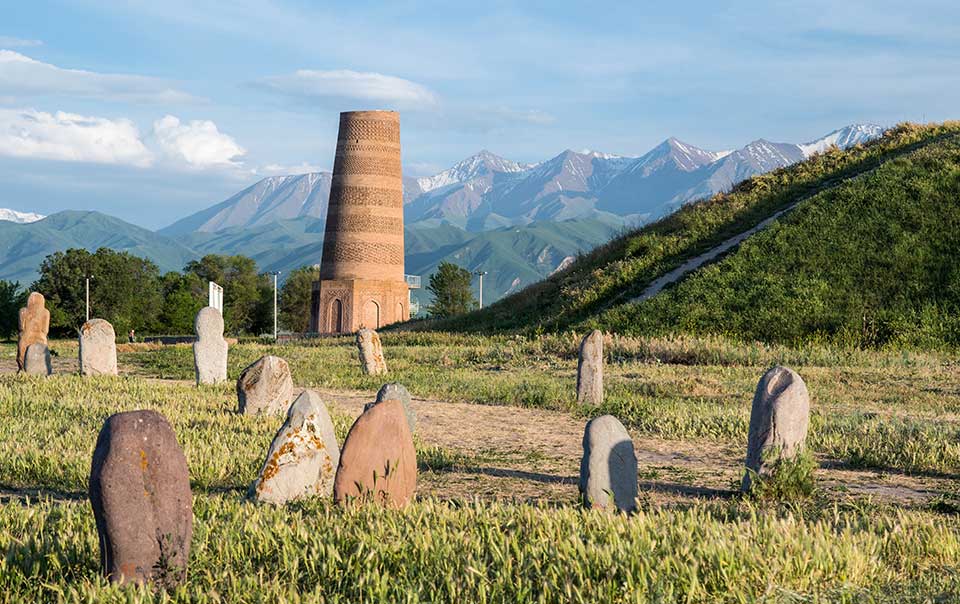
Perfect for culturally curious travelers who want more than a standard sightseeing trip. Ideal for those who want a balanced combination of nature, authentic nomadic life, UNESCO heritage cities, and real Silk Road history — all in one seamless journey across three countries.