At the end of 2025, Kyrgyzstan’s revenues from the export of tourism services reached a historic mark of $1.098 billion. According to the National Statistical Committee, this is 8.1% more than the previous year. The contribution of the hospitality industry to the republic’s GDP was 3.8%, and the added value of the sector exceeded 74.4 billion soms.
At first glance, the statistics demonstrate an unconditional triumph. The country has finally overcome the consequences of the 2020 pandemic, when tourism’s share in the economy fell to 2.9%, and the volume of service exports decreased to $120.4 million.
By 2025, about 129 thousand entrepreneurs and companies were employed in the organized tourism sector, and the total number of vacationers in the republic amounted to 3.6 million people. At the same time, more than 10 million crossings of the state border by foreign citizens are recorded through official channels.
However, serious structural problems are hidden behind the facade of optimistic figures. An analysis of the National Statistical Committee’s report on green economy indicators for the period from 2018 to 2024, as well as the opinions of industry officials and market participants, indicate that the current model of tourism development in the KR is close to its limit.
The industry is growing mainly extensively — through construction and increasing pressure on natural resources. At the same time, the market faces a shortage of personnel, technological backwardness, and dissatisfaction of local communities.
Imbalance of investments and infrastructure deadlock
According to official statistics, the volume of fixed assets introduced amounted to an impressive 44 billion 387 million soms. Investments in fixed capital exceeded 23 billion 313 million soms. But if we analyze the structure of these investments in detail, a dangerous bias becomes noticeable.
The vast majority of funds — 21 billion 18 million soms — went to contract construction work. At the same time, only 247 million soms were spent on the purchase of equipment, tools, and inventory. The share of investments in technological equipment and digitalization amounted to only 1% of the total investment volume.
In fact, the industry is expanding in breadth, increasing square meters, but not qualitatively renewing. By the end of the year, the country had 842 large recreation facilities (including 388 hotels) and 2.3 thousand guest houses. At the same time, many of them still depend on the short summer season and do not have modern management systems.
Director of the State Agency for Tourism Development under the Cabinet of Ministers of the KR Eduard Kubatov emphasizes that without basic infrastructure, the industry will reach a dead end: “Our goal is to attract tourists who can enjoy our nature, relax, get the best impressions of the country and at the same time leave a noticeable contribution to the economy. Last year we recorded more than 10 million tourists. This year we expect about 12 million. Tourism’s contribution to the economy already exceeds $1 billion and will grow because the industry creates jobs and provides a high level of employment for the local population. Tourism is an industry of well-being. Without economic well-being and a sustainable state of the economy, tourism cannot develop. When I say ‘infrastructure’, I primarily mean roads, electrical networks, communications, treatment facilities. We need to basically put the industry in order and create uniform rules for the functioning of the tourism industry.”
In addition, the head of the state agency draws attention to the need for clear filtering of the incoming flow. Of more than 10 million foreigners entering the republic, a significant part travels for private affairs, for border trade or transit. Without separating the real tourist flow and migration movement, it is difficult to build an accurate state strategy.
Economic domino and exacerbation of social inequality
Tourism is often called a driver of regional development. From a theoretical point of view, this thesis is confirmed by independent analysts.
Chief expert of the analytics and coordination department of NISI PKR Beksultan Momunbekov explains the macroeconomic effect of the sector: “Tourism works like an economic domino. According to the methodology of the World Travel and Tourism Council (WTTC), one job in this area creates three to four jobs in related industries. The tourist paid the guide — the guide bought products from the farmer — the farmer hired a worker — and so on down the chain to the most remote mountain village.”
However, in practice, this “domino” is distributed extremely unevenly. The geography of investments remains rigidly centralized: fixed capital settles in Bishkek and on the shores of Issyk-Kul. And although recently there has been a breakthrough in the Batken region (where over $109 million was directed in a year), the distribution of income within the tourist locations themselves is causing growing social tension.
Large tour operators, taking a significant part of the high check from foreign guests, often use residents of the regions as cheap service labor. Local communities remain on the periphery of the profitable business.
Entrepreneur Baktygul Isaeva from the Issyk-Kul region describes the situation from the inside: “The regions get mere crumbs from the common tourism pie. Usually, large companies order the most basic and cheap service from local families: spend the night, cook lunch, sell souvenirs or rent out horses. Village residents are practically cut off from marginal services. They do not work as drivers on expensive transfers, they are not hired as qualified guides or instructors — these niches are occupied by visiting specialists. We are simply used as a cheap service base on the ground.”
Ecological crisis: pollution records and mountain degradation
The price for economic growth turned out to be high for Kyrgyzstan’s fragile ecosystem. In parallel with the growth of revenues, the National Statistical Committee’s report recorded a critical load on nature. Payments for land pollution in the country reached a historic maximum, amounting to 207.2 million soms. In the pre-pandemic year of 2019, this figure was almost three times less — 72.3 million soms.
The state is trying to respond: budget expenditures on environmental protection have tripled over several years, reaching 3.02 billion soms. Of these, 1.01 billion soms were directed to biodiversity protection, and 709.4 million soms to the maintenance of nature reserves and natural parks. But these measures are not yet keeping pace with the rate of anthropogenic pressure.
Only in 2025, 3,619 inspections of compliance with environmental and technical safety were carried out in Kyrgyzstan, during which 10,666 violations of legislation were identified.
Eduard Kubatov reminds that for Kyrgyzstan, ecology is the main economic asset, the destruction of which will nullify the country’s potential.
Tell us about your travel plans and we'll craft a personalized proposal within 24 hours. No pressure, no generic packages — just a genuine conversation about your dream trip.
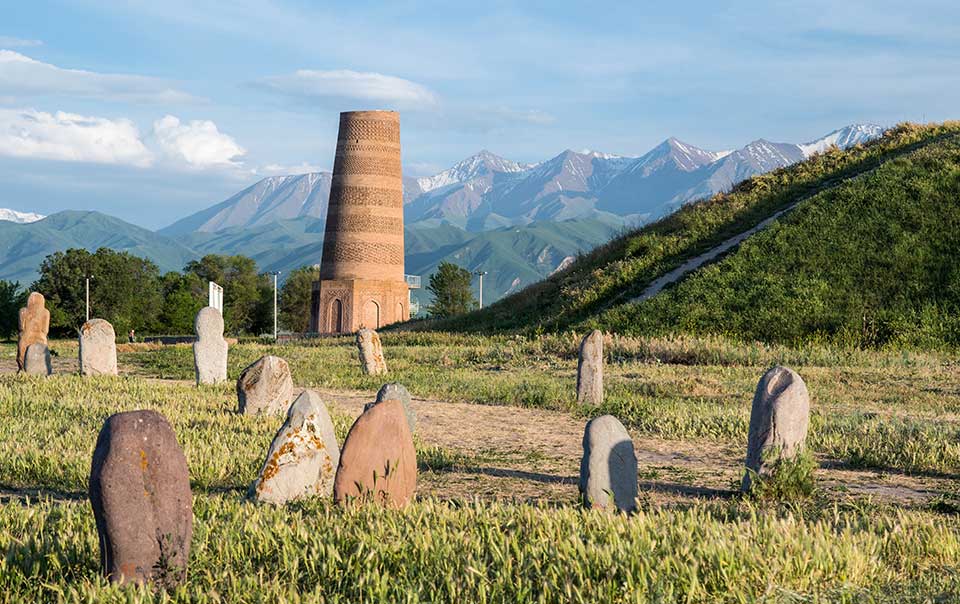
Perfect for culturally curious travelers who want more than a standard sightseeing trip. Ideal for those who want a balanced combination of nature, authentic nomadic life, UNESCO heritage cities, and real Silk Road history — all in one seamless journey across three countries.